
The Invisible Layer That Decides Whether You Survive or Fold
Most resellers blame their server when streams buffer. They blame their ISP when channels freeze. They blame their panel provider when credits vanish into the void. Almost nobody blames the middleware — because almost nobody understands what it actually does.
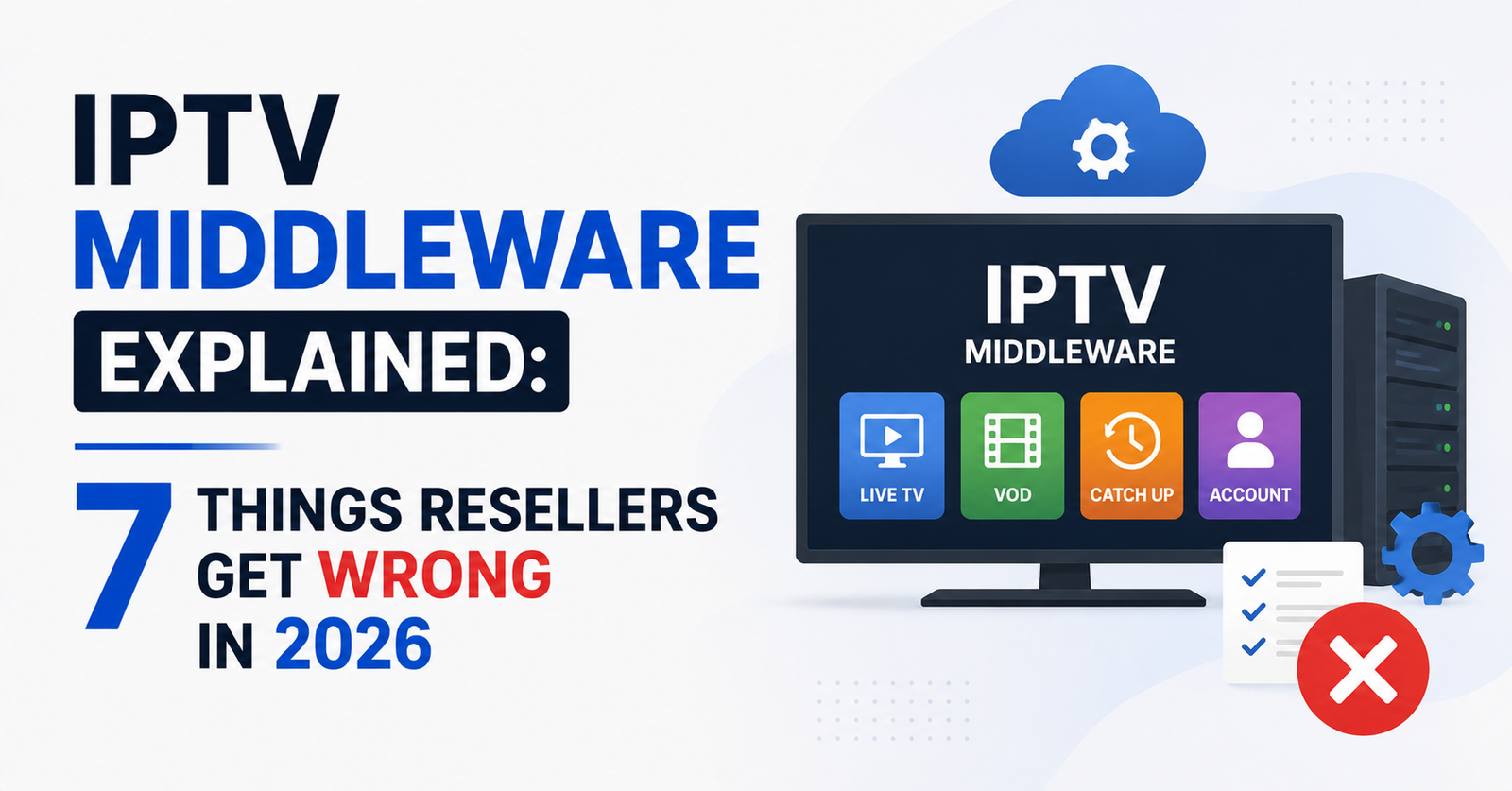
That’s the gap this article fills. IPTV middleware explained isn’t just a definition exercise. It’s the difference between running a sustainable reseller operation and constantly firefighting problems you can’t even name. Middleware is the orchestration layer sitting between your content delivery network and the end-user interface. It handles authentication, EPG injection, channel mapping, catch-up TV logic, stream routing, and billing hooks. When it works, you never think about it. When it fails, everything fails — and you won’t know where to look.
If you’ve ever wondered why two IPTV resellers using the same panel get wildly different subscriber experiences, middleware configuration is usually the answer. The panel is just the front desk. Middleware is the entire building management system behind it.
Pro Tip: Before troubleshooting any stream quality issue, check whether your middleware layer is properly handing off HLS segments. A misconfigured middleware timeout of even 2 seconds can cascade into buffering across every subscriber connection simultaneously.
What Middleware Actually Controls (And What It Doesn’t)
There’s a persistent myth that middleware and panel software are the same thing. They aren’t. Your panel — whether it runs on Xtream Codes, XUI, or a proprietary fork — is a management interface. Middleware is the engine underneath it.
Here’s a breakdown of what falls under middleware jurisdiction versus what doesn’t:
- Authentication & token validation — Middleware verifies whether a subscriber’s MAC address, username/password combo, or device token is valid before a single frame loads.
- Stream routing decisions — Which CDN node serves which region? Middleware makes that call in real time.
- EPG synchronisation — Your electronic programme guide doesn’t magically appear. Middleware pulls, parses, and maps EPG data to the correct channel IDs.
- Catch-up and timeshift logic — If your service offers 7-day replay, middleware manages the archive pointers.
- Billing API hooks — When a credit is consumed or a subscription expires, middleware triggers the state change.
What middleware does NOT do: it doesn’t transcode video, it doesn’t negotiate peering arrangements with ISPs, and it doesn’t write your channel playlist. Those are infrastructure and operations tasks. Confusing them with middleware creates troubleshooting nightmares.
Why IPTV Middleware Explained Matters More in 2026 Than Ever Before
The enforcement landscape has shifted. AI-driven ISP blocking is no longer theoretical — it’s active across multiple UK and European carriers. Deep packet inspection tools are smarter. What does this have to do with middleware?
Everything.
Middleware determines how your streams are requested, packaged, and delivered to subscriber devices. If your middleware makes predictable, pattern-heavy API calls, ISP-level filtering can fingerprint your traffic. Modern middleware implementations need to support encrypted handshake rotation, randomised segment request intervals, and fallback uplink routing when primary CDN paths get blocked.
| Feature | Legacy Middleware (Pre-2024) | Modern Middleware (2026 Standard) |
|---|---|---|
| Authentication | Static MAC/token | Rotating token + device fingerprint |
| Stream Requests | Fixed interval polling | Randomised segment fetching |
| Failover | Manual DNS switch | Automated uplink failover with health checks |
| EPG Delivery | Bulk XML push | Incremental JSON with delta updates |
| ISP Evasion | None | Encrypted handshake + header obfuscation |
Resellers still running legacy middleware stacks are operating on borrowed time. IPTV middleware explained at this level isn’t academic — it’s operational survival.
Pro Tip: Ask your panel provider whether their middleware supports automated uplink failover. If they don’t know what you mean, that tells you everything about their infrastructure maturity.
The Authentication Problem Nobody Talks About
Here’s a scenario every mid-size reseller has lived through: you sell 200 subscriptions over a weekend promotion. Monday morning, half your subscribers report they can’t connect. Your server isn’t down. Your panel shows active accounts. The streams are live.
The bottleneck? Middleware authentication throughput.
Every time a subscriber opens their app, the middleware layer validates their credentials against the database before allowing stream access. Legacy middleware handles these requests sequentially. With 200 concurrent authentication calls, your middleware becomes a queue — and queues mean timeouts, failed logins, and angry customers.
IPTV middleware explained at the authentication layer reveals why scaling isn’t just about adding server RAM. You need middleware that supports concurrent connection pooling, database read replicas for auth lookups, and cached session tokens that reduce repeated validation calls.
- Connection pooling prevents each auth request from opening a new database connection.
- Read replicas distribute authentication queries across multiple database nodes.
- Session caching means a returning subscriber doesn’t hit the database again within a configurable window (typically 15–60 minutes).
Without these, your infrastructure ceiling is your middleware’s auth throughput — regardless of how powerful your transcoding servers are.
Channel Mapping Gone Wrong: A Middleware Misconfiguration Classic
If you’ve ever had subscribers report that Channel 42 plays the wrong content, or that their EPG shows yesterday’s schedule, you’ve encountered a middleware mapping error. Channel mapping is the process where middleware assigns internal stream URLs to subscriber-facing channel numbers and names.
This sounds trivial. It isn’t.
A typical reseller operation handles 8,000 to 15,000 channel entries across multiple categories and countries. Each channel has a stream source URL, a backup URL, an EPG identifier, a logo URL, a category tag, and regional availability flags. Middleware maintains all of these relationships. A single mismatched EPG ID means one channel displays another channel’s schedule — and subscribers notice immediately.
Pro Tip: After any bulk channel update, run a middleware-level EPG audit. Cross-reference 10 random channels manually against their EPG source before pushing live. Five minutes of checking saves fifty support tickets.
The mapping problem compounds when panel providers push updates that reset custom channel configurations. If your middleware doesn’t version-control its channel map, you lose your customisations with every upstream update.
Load Balancing Through The Middleware Lens
Resellers hear “load balancing” and think of server-level distribution — NGINX configs, HAProxy setups, round-robin DNS. Those matter. But IPTV middleware explained from a load perspective reveals a different layer entirely.
Middleware-level load balancing decides which content node serves a specific subscriber based on:
- Geographic proximity to CDN edge nodes
- Current load on each node (active connections, bandwidth utilisation)
- Stream type (live versus VOD versus catch-up — each has different resource profiles)
- Subscriber tier (premium subscribers might route to dedicated low-latency nodes)
This is more intelligent than server-level load balancing because middleware understands the content context. A server-level load balancer treats every HTTP request equally. Middleware knows that a live premier league night generates 10x the concurrent demand of a Tuesday afternoon VOD session and can pre-allocate resources accordingly.
Without middleware-aware load distribution, you get the classic reseller complaint: “Everything works fine until the big match, then the whole system collapses.” That collapse is a middleware orchestration failure, not a bandwidth problem.
Credit Systems and Billing Logic: Where Middleware Meets Revenue
For resellers operating on a credit-based panel system — and most do — the middleware billing layer directly controls revenue flow. When you allocate a 12-month subscription to a subscriber, middleware deducts credits from your balance, sets an expiry timestamp, and manages renewal flags.
Here’s where it gets dangerous: if your middleware billing module isn’t atomic in its transactions, you risk credit leakage. That means credits get deducted without the corresponding subscription actually activating, or subscriptions activate without credits being deducted. Either scenario costs you money.
- Atomic transactions ensure that credit deduction and subscription activation happen as a single operation — both succeed or both fail.
- Billing reconciliation logs let you audit credit movements against active subscriptions.
- Grace period logic determines what happens when a subscription expires — does the subscriber get cut off instantly, or is there a configurable buffer?
IPTV middleware explained at the billing layer is where operational discipline separates profitable resellers from those bleeding credits without realising it. If you can’t pull a reconciliation report from your panel that matches your credit purchases, your middleware billing logic has gaps.
Pro Tip: Run a monthly credit audit. Compare total credits purchased against total credits allocated plus current balance. Any discrepancy above 2% indicates a middleware billing integrity issue that needs immediate investigation.
DNS Poisoning, Middleware, and Why Your Backup Uplink Strategy Matters
DNS poisoning is one of the most disruptive threats to IPTV delivery in 2026. When an ISP or regulatory body poisons DNS records for your streaming domains, subscriber apps can’t resolve the server address — and your entire operation goes dark.
Middleware’s role here is critical. Well-configured middleware supports hardcoded IP fallback lists, encrypted DNS (DoH/DoT) for resolution, and automatic domain rotation when primary domains become unreachable. Without middleware handling this logic, each subscriber would need manual reconfiguration every time a domain gets blocked — which is neither scalable nor practical.
Your backup uplink servers are the second half of this equation. Middleware should monitor primary uplink health continuously and reroute traffic to backup uplinks within seconds of detecting failure. The subscribers should never know a switch happened.
| Scenario | Without Middleware Failover | With Middleware Failover |
|---|---|---|
| Primary DNS poisoned | Full service outage until manual fix | Automatic switch to backup domain/IP |
| Primary CDN overloaded | Buffering and dropouts across all users | Intelligent reroute to secondary CDN |
| ISP blocks primary port | Service down for affected ISP’s customers | Port rotation triggered automatically |
| Uplink server crash | Manual restart required | Backup uplink activated in under 5 seconds |
IPTV middleware explained in the context of DNS resilience is non-negotiable knowledge for any reseller operating at scale. If your middleware doesn’t handle failover autonomously, you’re one DNS entry away from losing your entire subscriber base overnight.
HLS Latency and Middleware Segment Handling
HLS — HTTP Live Streaming — is the dominant delivery protocol for IPTV. It works by breaking a live stream into small segments (typically 2–10 seconds each) and serving them sequentially. Middleware manages the segment playlist, decides buffer depth, and controls how aggressively the player fetches ahead.
HLS latency — the delay between the live event and what the subscriber sees — is largely a middleware configuration issue. Shorter segments reduce latency but increase the number of HTTP requests, stressing your infrastructure. Longer segments are more efficient but create noticeable delay, which is a deal-breaker for live sports.
IPTV middleware explained at the HLS layer means understanding the trade-off matrix:
- 2-second segments: Low latency (~6–8 seconds behind live), high server request volume.
- 6-second segments: Moderate latency (~18–20 seconds), moderate request volume.
- 10-second segments: High latency (~30+ seconds), low request volume but poor live experience.
Most resellers have no idea their middleware is configured for 10-second segments by default. Changing this to 4-second segments can dramatically improve live viewing experience — but only if your CDN and server infrastructure can handle the increased request rate.
Panel Management: The Middleware Interface Most Resellers Misunderstand
Your reseller panel — the dashboard where you create subscribers, assign packages, and monitor connections — is a middleware frontend. Every button click in your panel triggers a middleware API call. Understanding this relationship changes how you troubleshoot.
When a subscriber account fails to activate after you click “Create,” the problem isn’t the panel UI. The problem is the middleware API call that the panel triggered. Maybe the API timed out. Maybe the middleware database was locked. Maybe a validation rule in the middleware rejected the input silently.
Resellers who understand IPTV middleware explained at this interface level stop wasting time refreshing their panel and start checking middleware logs. That’s where the real diagnostic information lives.
- Check middleware API response codes (200 = success, 500 = server error, 408 = timeout).
- Monitor middleware queue depth during peak creation periods.
- Ensure your panel’s API timeout is set longer than your middleware’s processing time for batch operations.
Pro Tip: If you’re creating more than 50 subscriber accounts in a batch, do it during off-peak hours. Middleware API calls compete with subscriber authentication requests for database access — and authentication should always win priority.
Customer Churn and The Middleware Experience Gap
Subscriber churn in IPTV is brutal. Industry averages hover around 15–25% monthly for reseller operations. Most resellers attribute churn to content issues or price sensitivity. The real driver, more often than not, is experience quality — and experience quality is a middleware output.
When middleware handles EPG sync poorly, subscribers see blank programme guides. When middleware authentication is slow, subscribers stare at loading screens. When middleware failover is absent, subscribers experience outages that their Netflix subscription never shows them.
IPTV middleware explained through the lens of churn reduction reveals actionable interventions:
- Implement middleware-level connection quality monitoring per subscriber.
- Set up automated alerts when a subscriber’s stream drops exceed a threshold.
- Use middleware data to proactively contact subscribers experiencing issues before they cancel.
Retention isn’t a marketing problem for IPTV resellers. It’s a middleware telemetry problem. If your middleware doesn’t give you per-subscriber quality metrics, you’re flying blind on churn.
Frequently Asked Questions
What exactly is IPTV middleware and how does it differ from a panel?
IPTV middleware is the orchestration engine operating beneath your reseller panel. While the panel provides your user interface for managing subscribers and credits, middleware handles the backend processes — authentication, stream routing, EPG mapping, billing transactions, and failover logic. Think of your panel as the steering wheel and middleware as the entire drivetrain underneath.
Can I change my middleware without switching panel providers?
In most cases, no. Middleware is tightly integrated with panel software like Xtream Codes or XUI. Switching middleware typically means migrating your entire panel ecosystem, including subscriber databases and credit balances. Some modular panel solutions allow middleware component swaps, but these are uncommon in the reseller market as of 2026.
How does IPTV middleware explained at the ISP level help avoid blocks?
When IPTV middleware explained at the ISP interaction layer, it reveals how stream request patterns can be fingerprinted by AI-driven deep packet inspection. Modern middleware mitigates this by randomising segment fetch intervals, rotating encrypted handshakes, and supporting automatic domain/IP failover when primary paths are blocked.
Why does my IPTV service buffer only during peak hours?
Peak-hour buffering typically points to middleware authentication bottleneck or inadequate load distribution logic. When concurrent users spike, middleware processes authentication sequentially unless configured with connection pooling and session caching. The streams themselves may be fine — the bottleneck is middleware letting subscribers access them.
What middleware settings reduce subscriber churn the most?
Three settings have the highest impact: reducing HLS segment duration to 3–4 seconds for better live latency, enabling automated uplink failover for zero-downtime switching, and activating per-subscriber quality monitoring so you can intervene before issues drive cancellations. These are middleware-level configurations, not server-level.
Is middleware responsible for credit discrepancies in my panel?
Yes. Middleware manages the billing transaction logic. If credit deductions and subscription activations aren’t handled as atomic operations, you’ll see mismatches — credits deducted without activation, or active accounts with no corresponding deduction. A monthly reconciliation audit catches these gaps before they compound.
How does catch-up TV work at the middleware level?
Middleware maintains archive pointers for recorded streams, mapping each channel’s past content to timeshift windows (usually 24 hours to 7 days). When a subscriber requests catch-up playback, middleware locates the correct archive segment, validates the subscriber’s package includes catch-up access, and routes the archived stream through the CDN. Any misconfiguration breaks replay silently.
Do I need backup uplink servers if my middleware already handles failover?
Middleware failover logic only works if backup infrastructure exists to fail over to. Middleware monitors uplink health and reroutes traffic automatically — but it needs at least one healthy backup destination. Without physical or virtual backup uplinks provisioned and connected, middleware failover has nowhere to send your subscribers.
Your Middleware Operations Checklist
- Audit your middleware authentication throughput — confirm it supports concurrent connection pooling, not sequential processing.
- Verify HLS segment duration settings — switch from default 10-second segments to 3–4 seconds if your CDN infrastructure supports the request volume.
- Test your automated uplink failover — deliberately disable your primary uplink and measure how quickly middleware reroutes to backup.
- Run a credit reconciliation — compare total purchased credits against total allocated plus remaining balance. Flag any discrepancy above 2%.
- Spot-check 10 random channel EPG mappings after every bulk update — five minutes prevents fifty support tickets.
- Confirm your middleware supports encrypted DNS resolution (DoH/DoT) and domain rotation for ISP blocking resilience.
- Enable per-subscriber stream quality monitoring — if your middleware doesn’t offer this, it’s time to evaluate providers who do.
- Review your middleware API timeout settings — ensure they exceed your database processing time during peak batch operations.
- Document your middleware configuration version — if an upstream panel update resets your customisations, you need a restoration reference.
- Start building your reseller operation on infrastructure that matches your ambition — explore panel and credit options at BritishSeller to see what a properly provisioned ecosystem looks like.