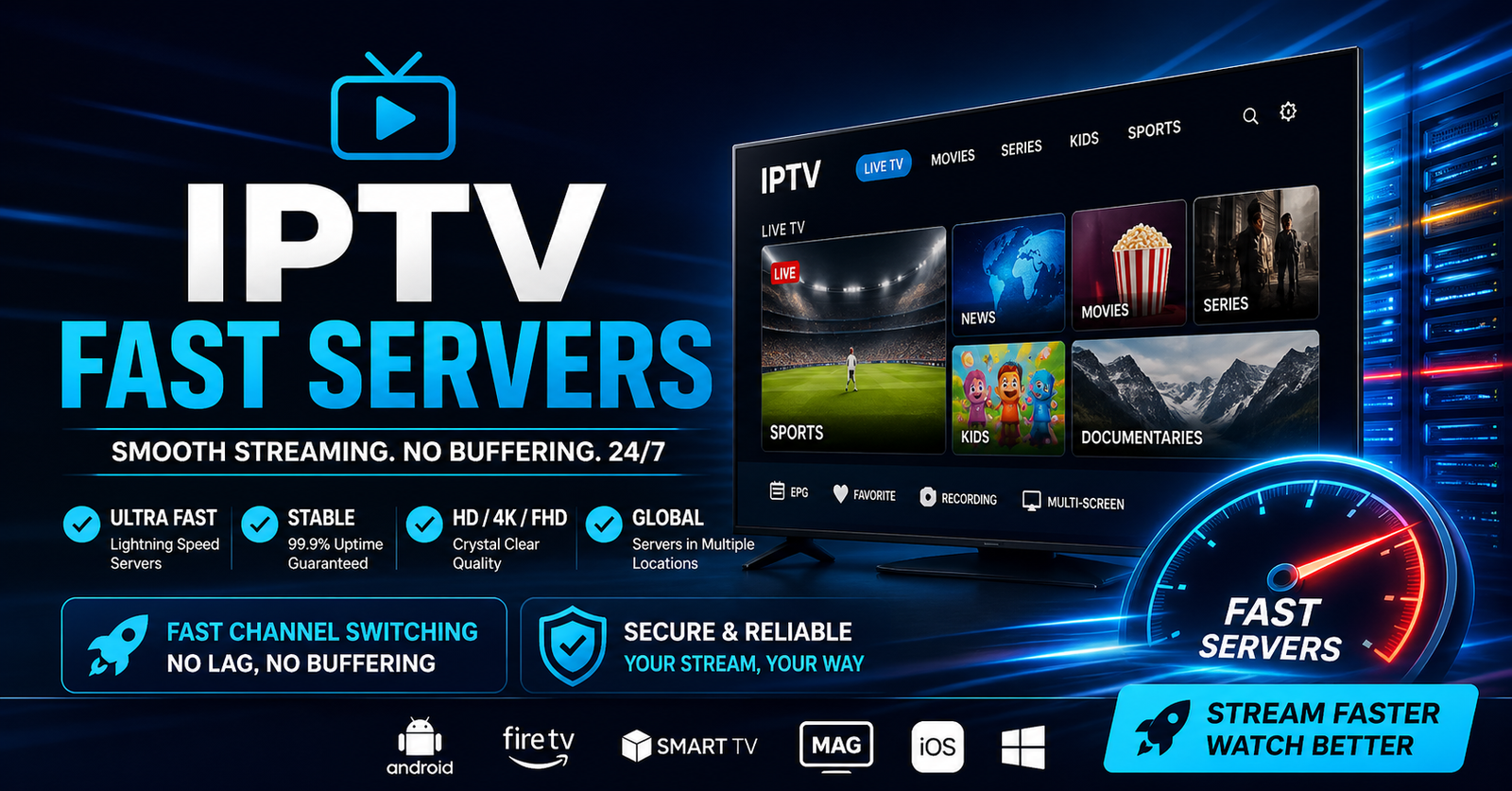

Let’s cut through the noise immediately. When a customer messages you at 11 PM saying “it’s buffering again,” your first instinct is to blame the provider. But nine times out of ten, the real culprit is something you either ignored at setup or didn’t know to ask about — the server infrastructure beneath your panel. IPTV fast servers aren’t just about download speed. They’re about architecture, geographic proximity, load distribution, and how your provider reacts when one node collapses under pressure.
Most resellers learn this the hard way. You don’t.
What Actually Sits Behind IPTV Fast Servers
Think of IPTV fast servers less like a single high-speed pipe and more like a nervous system. Premium-grade infrastructure — the kind used by serious UK IPTV reseller panels like those at BritishSeller.co.uk — runs on multi-layered delivery networks where each component handles a specific function: transcoding, authentication, content caching, and stream relay.
When one layer experiences congestion, the others compensate. That’s the core principle behind enterprise-grade IPTV fast servers. Cheap providers skip this entirely and hand you a single origin server dressed up in marketing language.
The telltale signs of weak infrastructure:
- HLS latency spikes during peak hours (evenings, weekends, major sporting fixtures)
- Buffering that appears specifically on HD or 4K streams, not SD
- EPG data that lags or fails to load independently of the stream
- Panel authentication delays — you try to create a line and it times out
Pro Tip: Always ask your provider where their origin servers are physically located. A provider claiming “UK optimised” delivery but hosting servers exclusively in Eastern Europe adds 80–120ms of unnecessary latency to every single stream your customers watch.
The 2026 ISP Blocking Reality and How IPTV Fast Servers Absorb It
Here’s something most reseller guides won’t tell you: ISP-level blocking in 2026 has evolved dramatically. Major broadcasters and their enforcement partners now deploy AI-assisted DNS poisoning, deep packet inspection triggers, and dynamic domain rotation attacks that specifically target streaming infrastructure.
What this means for you operationally: a provider using static IP delivery with no rotation or failover layer is not operating IPTV fast servers — they’re operating a slow-moving target.
Platforms with genuine IPTV fast servers handle ISP blocking through:
- Automatic domain rotation when a primary URL gets flagged
- Anycast routing that redirects traffic through alternate geographic nodes
- Encrypted stream tunnelling that obfuscates content signatures from DPI scanners
| Infrastructure Type | Response to ISP Block | Customer Impact |
|---|---|---|
| Single origin server | Complete outage | Immediate churn |
| Basic multi-server | Partial failover, manual fix needed | 30–90 min downtime |
| IPTV Fast Servers (enterprise) | Automatic reroute in under 3 seconds | Near-zero visible disruption |
The difference in customer retention between the first and third row in that table is not small. It’s the difference between a business and a hobby.
Why Load Balancing on IPTV Fast Servers Determines Your Refund Rate
During peak events — a major football final, a boxing night, a live pay-per-view — amateur providers collapse because they never load-tested beyond theoretical capacity. Enterprise IPTV fast servers use dynamic load balancing, meaning traffic is automatically redistributed across available nodes based on real-time connection counts.
Here’s the operational reality: if your provider cannot tell you what their concurrent connection ceiling is per server node, they haven’t engineered for scale. They’ve just bought bandwidth and hoped for the best.
What to demand from any provider you commit to:
- Minimum 3 active backup uplink servers (active, not standby)
- Automatic failover triggering in under 5 seconds
- Separate server nodes for VOD versus live stream delivery
- A real-time status dashboard you can access during incidents
Pro Tip: Request a stress test. Activate 20 concurrent streams on your trial account during a peak sports window. If HLS latency climbs above 6 seconds or streams drop entirely, walk away regardless of price.
Panel Credit Models and How They Connect to Server Costs
There’s a reason why providers offering genuinely fast IPTV fast servers — with proper failover, load balancing, and anti-blocking infrastructure — price their credits differently from bargain operators.
Infrastructure costs money. BritishSeller.co.uk, for instance, structures its reseller credits at approximately £1.50 per credit, with each credit representing one month’s subscription for one customer. That pricing reflects real infrastructure overhead — not padding.
When you see credits priced at pennies with unlimited connections per line and no concurrent limits, you’re not getting a deal. You’re getting a server that will melt under normal usage because the provider oversold capacity they don’t have.
Profitable reseller economics work like this:
- Buy credits at £1.50, sell subscriptions at £8–12/month per customer
- Scale to 50 active customers = £400–600/month revenue from a £75 credit investment
- 30-day refund protection on quality panels means zero-risk trial periods
The margin is healthy. But only if the IPTV fast servers underneath actually hold under load.
The Backup Uplink Problem Nobody Talks About
Your primary server goes down. This isn’t a hypothetical — it’s a scheduled certainty in this industry. The question is never “will it happen” but “how fast does your system recover.”
Backup uplink servers are the unsung architecture of reliable IPTV fast servers. They’re not the same as backup content servers. Uplink servers handle the external connection handoff — the bridge between your provider’s network and the wider internet. If that uplink degrades (DDoS, routing incident, data centre power event), every customer on that node hits a wall simultaneously.
Quality operators maintain:
- Geographically distributed uplink nodes (not two servers in the same data centre)
- BGP routing redundancy to prevent single-path failures
- Out-of-band management so engineers can access and reroute even during total connectivity failure
Without these, even the fastest IPTV fast servers become useless the moment their uplink degrades.
Pro Tip: During onboarding conversations with any provider, ask specifically: “Where are your backup uplink servers located, and what triggers automatic failover?” Vague answers mean the infrastructure doesn’t exist. Specific answers with millisecond thresholds mean you’re talking to operators.
Customer Churn Psychology: What Buffering Actually Costs You
You can acquire a customer for £0 through word of mouth. You can lose them permanently over a single bad buffering experience during a match they care about. The psychology here is brutal and asymmetric.
IPTV fast servers reduce churn not just by improving the technical experience — they reduce the anxiety customers carry about whether the service will work when it matters. That confidence translates directly into renewals, referrals, and premium tier upgrades.
IPTV UK Resellers who operate on properly maintained IPTV fast servers report:
- Renewal rates above 70% at the 3-month mark
- Organic referrals averaging 1.3 new customers per existing subscriber
- Significantly lower support ticket volume, reducing time spent firefighting
Contrast this with resellers running bargain infrastructure: constant support messages, refund demands, and churn rates that force perpetual new customer acquisition just to stay flat.
7 Best Ways to Become an IPTV Reseller in 2026
- Choose a panel backed by IPTV fast servers with verified multi-server failover (BritishSeller.co.uk offers automatic failover under 3 seconds)
- Start with a minimum credit package to test real-world performance before scaling investment
- Stress test during peak events — activate concurrent streams during a major live broadcast before selling to customers
- Verify uplink redundancy — ask for specific data centre locations and failover trigger thresholds
- Price your subscriptions for margins, not for competition — if IPTV fast servers cost more to support, your pricing must reflect that
- Build a 30-day refund window into your customer terms — this reduces dispute escalations and mirrors what quality providers offer you
- Monitor your panel’s status dashboard weekly — resellers who catch server degradation early resolve issues before customers even notice
Reseller Success Checklist
- Confirmed provider runs minimum 3 active backup server nodes
- Tested HLS latency during peak hours — under 4 seconds consistently
- Verified automatic failover (not manual intervention required)
- Confirmed anti-DNS-poisoning routing is active on IPTV fast servers
- Reviewed credit pricing against realistic margin calculations
- Received direct answer on uplink server locations and BGP redundancy
- Established a customer support response SLA before first sale
- Activated trial credits and tested on Firestick, Smart TV, and mobile simultaneously
- Confirmed EPG accuracy on UK channels independently of stream stability
- Panel accessible and manageable without technical background
The operators who build lasting reseller businesses in 2026 aren’t the ones who found the cheapest credits. They’re the ones who understood that IPTV fast servers are the foundation — and chose providers who treat infrastructure as a non-negotiable, not an afterthought.