
There’s a particular kind of silence that hits when your panel goes offline at 8:47 PM on a Saturday — right when half the country’s settling in for the evening’s main event. Your phone starts buzzing. Then it doesn’t stop. Thirty-seven messages in eleven minutes, all variations of the same question: “Why isn’t my IPTV working?”
That silence on the backend, paired with chaos on the frontend, is something every reseller remembers. And almost always, it traces back to one decision made weeks or months earlier — the choice of IPTV panel provider.
This isn’t a glossy overview of “top providers.” This is the article I wish someone had handed me before I signed up with my first IPTV panel provider, loaded credits, onboarded forty-odd subscribers, and watched the whole thing collapse because the infrastructure behind the curtain was held together with string and hope.
If you’re a IPTV reseller — whether you’re running a small family-and-friends setup or managing hundreds of lines — the provider you sit behind determines everything.
Let’s pull this apart properly.
What an IPTV Panel Provider Actually Controls (And Why It Matters More Than You Think)
Most newcomers treat the IPTV panel provider decision like picking a mobile phone contract. Compare a few prices, check the channel count, pick the cheapest one with the most logos on the website. That approach gets people burned constantly.
Your IPTV panel provider isn’t just giving you a login and a credit balance. They control:
- Stream routing and server architecture — where your subscribers’ connections actually land
- Content delivery uplinks — the backbone feeds that determine picture quality and reliability
- Panel software stability — whether Xtream Codes or Stalker middleware runs clean or crashes under load
- DNS and CDN configuration — the layer that either protects your operation or leaves it exposed to ISP-level blocking
When a subscriber complains about buffering during peak hours, they blame you. But the fault almost always sits with the IPTV panel provider’s infrastructure choices — load balancers stretched too thin, no regional failover, or backup uplink servers that exist on paper but never actually kick in.
Pro Tip: Before committing credits to any IPTV panel provider, ask for a 24-hour test line and hammer it specifically between 7–10 PM GMT on a weekend. That window exposes every infrastructure weakness that daytime testing hides.
The Credit Economy: How Pricing Models Reveal Provider Quality
Here’s something that trips up resellers constantly. Two IPTV panel provider options sit in front of you — one charges £4 per credit, the other charges £7. The instinct screams to go cheaper. That instinct is usually wrong.
The credit pricing model in the IPTV reseller ecosystem isn’t arbitrary. It reflects the cost structure behind the scenes. A provider offering rock-bottom credit rates is either:
- Overloading servers beyond safe capacity to offset thin margins
- Using single-source uplinks with no redundancy
- Operating on borrowed time before the next infrastructure bill catches up
The £7 provider might be running dedicated load balancing across three geographic nodes, maintaining backup uplink servers that activate within seconds of a primary failure, and actually investing in HLS latency optimisation so your subscribers get smooth playback rather than constant rebuffering.
| Factor | Budget IPTV Panel Provider | Premium IPTV Panel Provider |
|---|---|---|
| Credit Cost | £3–5 per line | £6–9 per line |
| Server Nodes | 1–2 (usually same country) | 3–5 (multi-region) |
| Uplink Redundancy | None or single backup | Dual/triple failover |
| Peak-Hour Stability | Frequent buffering | Consistent playback |
| Panel Uptime (monthly) | 92–96% | 99.2%+ |
| Support Response | Hours or days | Under 30 minutes |
That table isn’t theoretical. It’s drawn from watching resellers churn through three or four providers in a single year because they kept chasing the cheapest credits.
ISP Blocking in 2026: What Your IPTV Panel Provider Should Be Doing About It
The blocking landscape has shifted dramatically. It’s no longer just DNS-level interference that a simple server change sorts out. By mid-2025, major UK and European ISPs began deploying AI-driven deep packet inspection that identifies IPTV streaming patterns regardless of the domain or IP being used.
What does this mean for your choice of IPTV panel provider?
It means the provider’s response to blocking is now a core infrastructure competency, not an afterthought. A competent provider in 2026 should be actively implementing:
- Rotating CDN endpoints that cycle on short intervals, staying ahead of pattern-based detection
- Encrypted tunnelling options built into the panel’s output streams rather than leaving subscribers to configure their own VPN
- DNS poisoning countermeasures at the server level — not just telling users to switch to Cloudflare DNS and hoping for the best
Pro Tip: Ask any prospective IPTV panel provider what specific steps they took during the last major ISP clampdown. If the answer is vague or amounts to “we changed the DNS,” walk away. Competent providers will reference CDN migration, protocol-level encryption changes, or server relocation — specifics that demonstrate operational experience.
The resellers who survive enforcement waves are the ones whose IPTV panel provider treats blocking as an engineering problem, not a customer-service inconvenience.
Why Subscriber Churn Starts at the Panel Level
Let’s talk about something resellers rarely connect properly: your churn rate is a direct reflection of your IPTV panel provider’s reliability. Not your pricing. Not your customer service speed. The panel’s backend stability.
A subscriber who experiences three buffering episodes in a fortnight doesn’t message you about it. They just don’t renew. They vanish. And you’re sat there wondering why your renewal rate dropped from 78% to 51% in a quarter.
The psychology behind it is straightforward. IPTV subscribers are paying for convenience and reliability. The moment the service feels unreliable, they’re already shopping around — and there are dozens of resellers in every Facebook group and Telegram channel ready to promise smoother streams.
This makes your IPTV panel provider the single largest factor in customer lifetime value. Consider this breakdown:
- Month 1–2: Subscriber evaluates quality passively. Minor issues forgiven.
- Month 3–4: Tolerance drops sharply. A single prime-time freeze triggers comparison shopping.
- Month 5+: Either locked in as a long-term user or gone permanently.
That critical Month 3–4 window is entirely governed by backend stream quality — which your IPTV panel provider controls and you don’t.
Pro Tip: Track your renewal rates monthly and cross-reference them with your provider’s known outage dates. If dips correlate, the panel infrastructure is costing you subscribers regardless of what your pricing looks like.
Panel Software: Xtream Codes Isn’t the Only Conversation
Most reseller discussions about panel software begin and end with Xtream Codes. It’s the industry default, and for good reason — the interface is familiar, the M3U output is universal, and the credit management system is straightforward.
But an IPTV panel provider still running unmodified Xtream Codes in 2026 is telling you something about their technical investment. The platform’s core hasn’t seen meaningful development in years, and providers who genuinely prioritise stability have either:
- Forked and customised the codebase with proprietary load-handling modules
- Migrated to alternative panel frameworks that handle EPG management, multi-server balancing, and user authentication more efficiently
- Built hybrid systems that keep the Xtream Codes frontend (for reseller familiarity) while replacing the backend stream routing entirely
The EPG (Electronic Programme Guide) is a good litmus test. If your provider’s EPG data is perpetually misaligned — wrong times, missing channels, ghost listings — that’s not a minor cosmetic issue. It signals sloppy server-side management that likely extends to stream routing, credit handling, and uplink monitoring.
When evaluating an IPTV panel provider’s technical stack, ask:
- How frequently is EPG data refreshed? (Should be every 12–24 hours minimum)
- Are there separate servers handling EPG sync versus live stream delivery?
- What happens to active connections during a panel software update?
Scaling From 50 to 500 Lines Without Everything Breaking
The jump from a small reseller operation to a mid-scale one is where most IPTV panel provider weaknesses become catastrophic. At 50 subscribers, you can manage issues personally — a quick message here, a line reset there. At 500, you need systems, and those systems depend entirely on what your provider offers.
Scaling exposes three specific failure points:
Credit Management at Volume Buying 10 credits at a time works fine initially. At scale, you need bulk pricing tiers, automated renewal options, and transparent credit expiry policies. A reliable IPTV panel provider offers volume discounts that actually make commercial sense — not token 5% reductions that barely cover your transaction fees.
Sub-Reseller Architecture If you’re wholesaling lines to smaller resellers beneath you, the panel must support clean sub-reseller hierarchies. This means separate dashboards, independent credit pools, and activity logging that lets you monitor without micromanaging. Poorly implemented sub-reseller systems create billing nightmares at scale.
Load Distribution Transparency At 500 active connections during peak hours, you deserve to know how your provider distributes that load. Single-server architectures collapse. Multi-node setups with intelligent load balancing across geographic regions survive. Ask your IPTV panel provider for their node map — if they can’t or won’t share it, that opacity is itself a red flag.
Pro Tip: Before scaling past 200 lines with any provider, run a simultaneous connection stress test during peak hours. Load 30–40 test lines across different devices and monitor for quality degradation. The results tell you more than any sales pitch ever will.
The Backup Uplink Question Nobody Asks Until It’s Too Late
Uplink redundancy is the most ignored factor in IPTV panel provider evaluation, and it’s arguably the most important one. Your provider’s primary content feed — the source stream that everything else mirrors — has a failure rate. Every feed does. The question is what happens next.
A provider with no backup uplink servers delivers exactly what you’d expect when the primary goes down: a blank screen for every subscriber on every line you’ve sold. No fallback. No automatic switching. Just dead air and a flood of angry messages.
Competent providers maintain at least two independent uplink sources, with automated failover configured to switch within seconds rather than minutes. The best operations run three uplinks and use real-time quality monitoring to route traffic toward whichever source is delivering the strongest signal at any given moment.
This isn’t a feature you’ll see advertised on flashy landing pages. You have to ask. Specifically:
- How many independent uplink sources does the provider maintain?
- Is failover automated or manual?
- What’s the average switchover time during a primary uplink failure?
- Has the provider experienced a complete uplink outage in the last 12 months, and what happened?
The answers — or the evasion of answers — tell you everything about whether that IPTV panel provider is built for resilience or built for profit margins alone.
Risk Mitigation: Protecting Your Reseller Business From Provider Collapse
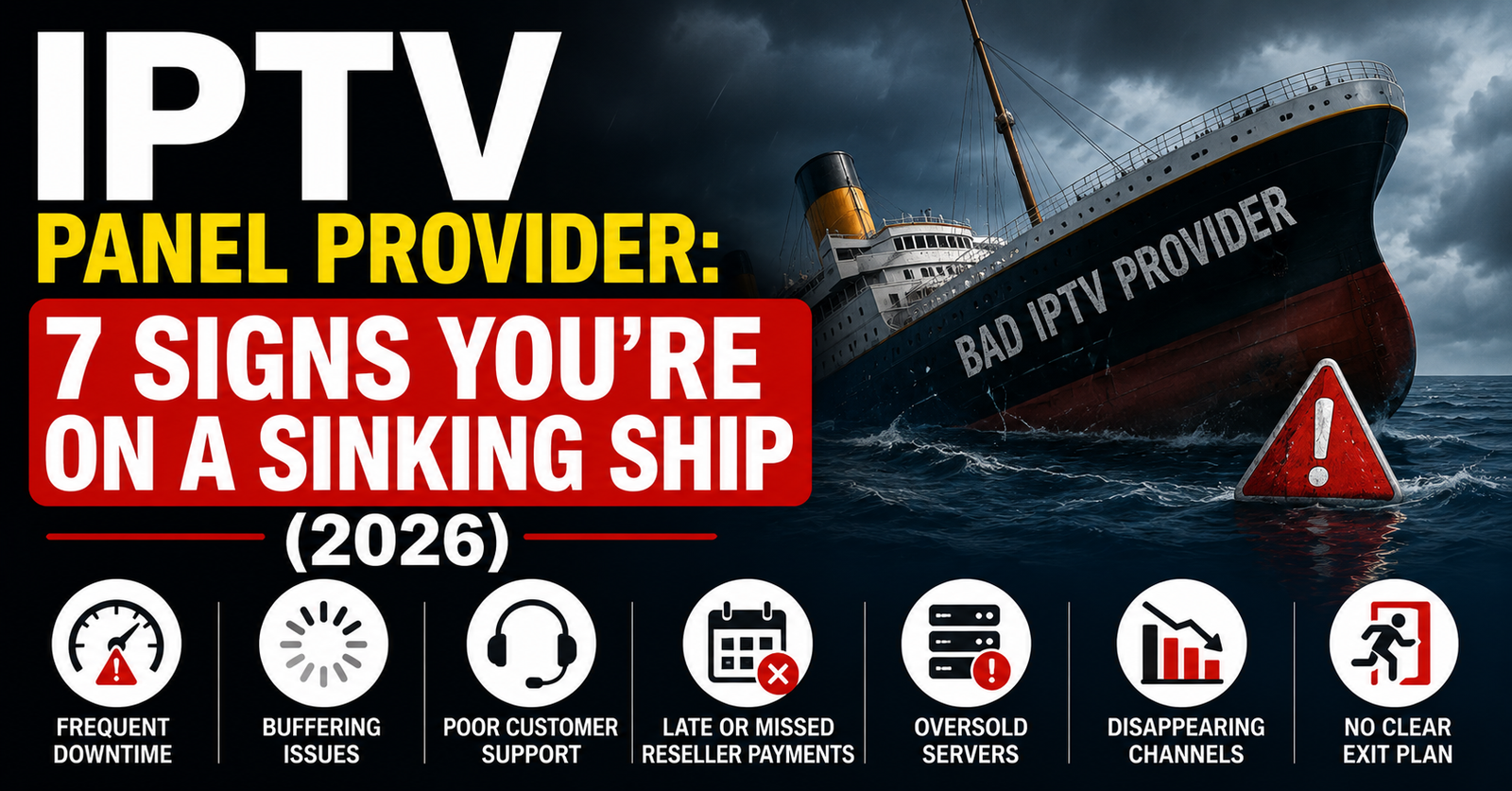
Here’s a reality that gets glossed over constantly: IPTV panel providers disappear. Sometimes overnight. Servers get seized, operators vanish, payment processors pull out. If your entire subscriber base sits on a single provider, you’re one bad Tuesday away from losing everything.
Smart resellers mitigate this by:
- Running dual-provider setups — splitting subscribers across two separate IPTV panel provider backends so a single failure never takes out the whole operation
- Maintaining offline subscriber records — exporting your customer list, renewal dates, and credit balances regularly rather than trusting the panel’s database as your only copy
- Diversifying payment collection — never relying solely on the provider’s built-in payment gateway; maintain your own invoicing and collection process through your own storefront
| Risk Scenario | Unprepared Reseller | Risk-Mitigated Reseller |
|---|---|---|
| Provider goes offline permanently | Loses all subscribers instantly | Migrates 50%+ to backup provider within hours |
| ISP blocks primary server | Total service outage until provider reacts | Switches DNS or redirects to alternate node |
| Panel software corrupted | Loses subscriber data and credit records | Restores from offline backup within a day |
| Payment processor drops provider | Cannot collect renewals | Collects independently via own site |
That second column isn’t hypothetical. Every experienced reseller has lived through at least one of those scenarios.
How to Actually Vet an IPTV Panel Provider Before Committing
Here’s what actually matters when you’re standing in front of a decision that will define your reseller operation for the next six to twelve months.
Step 1: Test During Adversity, Not Calm Request test lines and use them exclusively during peak demand windows. Any provider looks stable at 2 PM on a Wednesday.
Step 2: Interrogate the Support Structure Open a support ticket with a moderately technical question — something about HLS latency settings or EPG refresh cycles. Time the response. Evaluate the competence of the answer. If they take 18 hours to reply with a generic copy-paste, that’s your preview of what happens when 200 of your subscribers are screaming at you during a live event outage.
Step 3: Check Reseller Community Sentiment Not the provider’s own testimonials — actual reseller forums, Telegram groups, and communities where operators share unfiltered experiences. Look for patterns: repeated mentions of the same outage windows, credit disputes, or sudden price increases without infrastructure improvements.
Step 4: Demand Infrastructure Transparency A trustworthy IPTV panel provider will share basic architecture details without treating it as classified information. Server locations, uplink count, load balancing approach, and panel software version are reasonable questions. Refusal to answer any of them is itself an answer.
Frequently Asked Questions
How many backup uplink servers should a reliable IPTV panel provider maintain?
A minimum of two independent uplink sources with automated failover is the baseline for any provider worth considering. The strongest providers run three, with real-time quality monitoring that dynamically routes to whichever source delivers the best signal. Anything less leaves your operation vulnerable to single-point-of-failure outages that can take down every subscriber line simultaneously during peak demand windows.
Can I switch IPTV panel provider without losing all my subscribers?
Yes, but it requires preparation. Maintain an offline record of all subscriber details, renewal dates, and active line configurations outside the panel interface. When migrating, set up the new provider’s panel first, create matching lines, and transition subscribers in batches rather than all at once. Expect a 10–15% subscriber drop during any migration regardless of how smoothly it runs.
What causes buffering on IPTV and is it always the provider’s fault?
Buffering stems from three layers: the subscriber’s local internet connection, their ISP’s network management policies, and the IPTV panel provider’s server infrastructure. During isolated cases, the subscriber’s connection is usually responsible. When multiple subscribers report buffering simultaneously during peak hours, the fault almost certainly lies with the provider’s load handling or uplink capacity rather than individual connections.
How do I know if my IPTV panel provider is using load balancing properly?
Request the provider’s server node count and geographic distribution. During peak hours, check whether your test lines resolve to different IP addresses on repeated connections — this indicates active load distribution. If every connection lands on the same server regardless of timing or location, the provider likely isn’t running genuine load balancing despite what their marketing claims.
Is it worth paying more for a premium IPTV panel provider?
In nearly every case, yes. The cost difference between budget and premium providers typically ranges from £2–4 per credit. At scale, that difference is dwarfed by the revenue lost through subscriber churn caused by poor stream quality, peak-hour outages, and slow support response times. A provider costing £7 per credit with 99%+ uptime generates more profit than one costing £4 with frequent disruptions.
What should I do when my IPTV panel provider gets hit by ISP blocking?
First, check whether the block is DNS-level or deeper packet inspection. DNS blocks are resolved by switching resolver settings on subscriber devices. DPI-based blocks require the provider to implement encrypted tunnelling or rotate CDN endpoints. If your provider has no immediate response plan and simply tells you to “wait it out,” begin testing alternative providers immediately — that response pattern predicts future inaction.
How often should an IPTV panel provider refresh EPG data?
Every 12 to 24 hours at minimum. Stale EPG data — wrong programme times, missing channel listings, or ghost entries for defunct channels — creates a perception of unprofessionalism that subscribers associate with your service, not the backend provider. Ask specifically whether EPG sync runs on a dedicated server or shares resources with live stream delivery, as shared infrastructure often means EPG updates get deprioritised during high-traffic periods.
Can running two IPTV panel providers simultaneously actually work for a reseller?
Absolutely, and experienced resellers increasingly treat it as essential risk management. Split your subscriber base roughly 60/40 across two independent providers. Use the primary for your bulk operation and the secondary as both a live backup and a comparison benchmark. The operational overhead is minimal compared to the catastrophic cost of a single-provider failure wiping out your entire business overnight.
Reseller Success Checklist: Your Next 30 Days
- Audit your current IPTV panel provider’s uptime — pull your own records from the last 90 days and calculate actual availability percentage, not what they claim on their website.
- Run peak-hour stress tests this weekend — load 15–20 simultaneous test lines between 8–10 PM and document every buffer, freeze, and quality dip.
- Export your full subscriber list offline today — names, renewal dates, line details, credit balances. Store it somewhere completely independent from the panel.
- Open a test account with a second provider — don’t migrate anything yet, just establish the backup relationship and begin evaluating quality in parallel.
- Cross-reference your monthly churn rate against known outage dates — if the correlation is strong, your provider is costing you more in lost renewals than you’re saving on credit prices.
- Ask your provider three direct questions this week: uplink count, failover mechanism, and server node locations. Grade the response on speed, specificity, and transparency.
- Visit britishseller.co.uk for real-world reseller infrastructure insights — practical operational knowledge from people who’ve actually navigated provider failures, ISP blocks, and scaling challenges at ground level.
- Set a calendar reminder for 30 days from now — revisit this checklist, compare your stress test results, and make a final call on whether your current provider earns another quarter of your business or gets replaced.